


Larry Madowo sparked debate about Nigeria’s visa policy after he said he paid $80 for a single-entry visa at Murtala Muhammed International Airport.
In the viral clip posted on X, Madowo questioned why Nigeria charges visitors fees that many African countries do not.
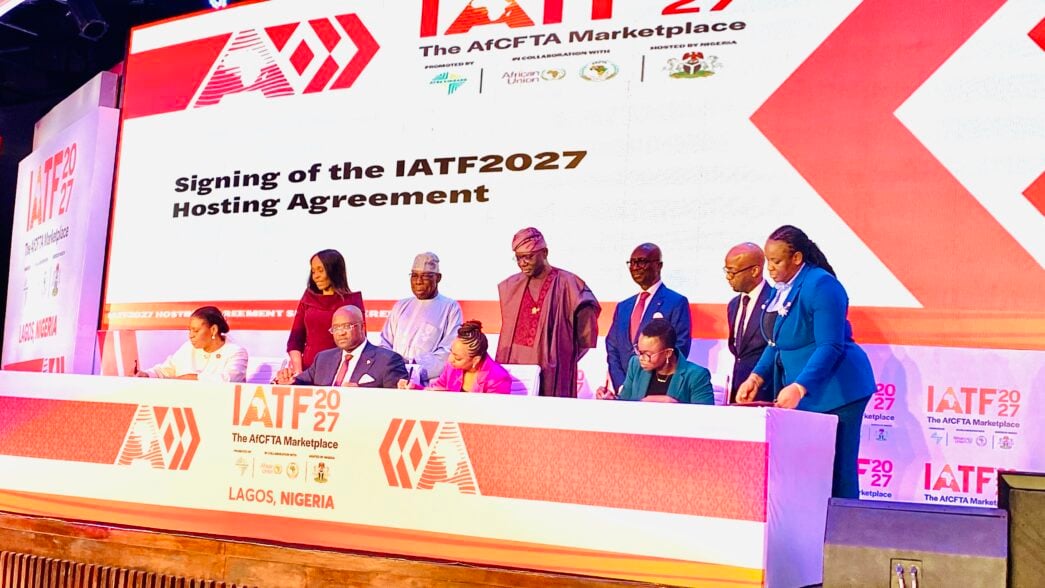
Later, Nigerian officials signed an agreement to host the Intra-African Trade Fair 2027 in Lagos, one of the continent’s largest commerce gatherings aimed at boosting trade across Africa.
The ceremony was led by Jumoke Oduwole and attended by former president Olusegun Obasanjo, who chairs the fair’s advisory council. Executives from African Export-Import Bank, including George Elombi and Francisca Tatchouop Belobe were also present.
Nigeria expects the event to draw more than 100,000 visitors from across the continent, including delegates from Kenya, South Africa, Egypt, Angola, Gabon, and Algeria.
But many of those visitors will have to pay to enter the country.
Under Nigeria’s Reciprocal Visa Fee Policy, the government charges foreign nationals roughly what their home countries charge Nigerian travellers. In practice, that means the cost of attending the fair will vary depending on the passport a visitor holds.
As Lagos prepares to host such a large continental event, visa access is becoming an important issue. While the policy is designed to ensure fairness between countries, strict entry requirements could discourage participation and reduce the event’s broader economic impact.
Easier visa access could boost attendance, increase tourism revenue, and signal Nigeria’s commitment to free movement under the African Continental Free Trade Area.
The trade fair itself will focus heavily on how technology and digitalisation can simplify investment, import, and export processes across African economies.

Participants are also expected to discuss aligning national laws with continental policies, simplifying visa rules for business travellers, and expanding the use of the Pan-African Payment and Settlement System to support regional trade.
“Nigeria is truly proud to host the Intra-African Trade Fair 2027 in Lagos, the birthplace and launchpad of African economic integration,” Oduwole said at the signing ceremony.
She pointed to Lagos’ historic role in regional cooperation. In 1975, the city hosted the signing of the treaty that created the Economic Community of West African States, the continent’s first regional economic bloc and a model for later integration initiatives.
Nigeria later reinforced ECOWAS’ free-movement framework by allowing citizens of member states to enter the country visa-free for up to 90 days.
More recently, in December 2019, former president Muhammadu Buhari announced that Nigeria would extend visas on arrival to all African passport holders starting in 2020, signalling support for greater mobility across the continent.
Despite those efforts, Nigeria’s standing on the Africa Visa Openness Index 2025, published by the African Development Bank and the African Union, has declined.
The country now sits outside the top 20 African nations for visa openness, after ranking sixth in 2024.
Part of that drop followed policy changes in 2025 when Nigeria, along with Guinea-Bissau, Mauritania, and Somalia shifted from a broad visa-on-arrival system to requiring travellers to obtain visas before departure. Although an e-visa platform was introduced, the index still classifies e-visas as visas obtained prior to travel.
Nigerian officials say the change was driven by security concerns and the need for reciprocity.
Pre-travel screening allows authorities to vet visitors before arrival, while reciprocal rules ensure countries that impose strict conditions on Nigerians face similar requirements.
Still, tighter visa policies do not necessarily prevent major continental events from succeeding.
In just four editions, the Intra-African Trade Fair has generated more than $167 billion in trade and investment deals, according to Afreximbank.
Algeria, which hosted the 2025 edition, recorded $48.3 billion in deals during the event, even though it ranks among the 10 least visa-open countries in Africa. More than 90% of African travellers must obtain visas through Algerian embassies before visiting.
Yet restrictive visa regimes can still have economic consequences.
Francisca Tatchouop Belobe of the African Union Commission warned that barriers to movement including visa restrictions, continue to slow intra-African trade.
“The first direction is with respect to non-tariff barriers and security concerns that continue to hinder intra-African trade,” she said during the signing ceremony.
Data from Afreximbank’s 2025 Intra-African Trade Report shows that trade between African countries reached $220.3 billion in 2024, but its share of total African trade fell to 14.5%.
The numbers suggest that obstacles such as visa restrictions and other non-tariff barriers are still limiting the continent’s economic integration.
Belobe said the trend reflects the slow adoption of the core principles behind the AfCFTA.
“Despite the signing of the AfCFTA by 54 African Union member states and ratification by 50 of them, countries are still slow in prioritising intra-African trade and harnessing the opportunities it creates,” she said.
Oduwole, however, said Nigeria has continued reviewing its policies to align with the agreement since signing on in 2021.
“Nigeria is proud to be the first AfCFTA state party to complete its five-year implementation review in 2025,” she said. “We now have a clearer understanding of the reforms and investments required to fully realise the promise of the AfCFTA.”