


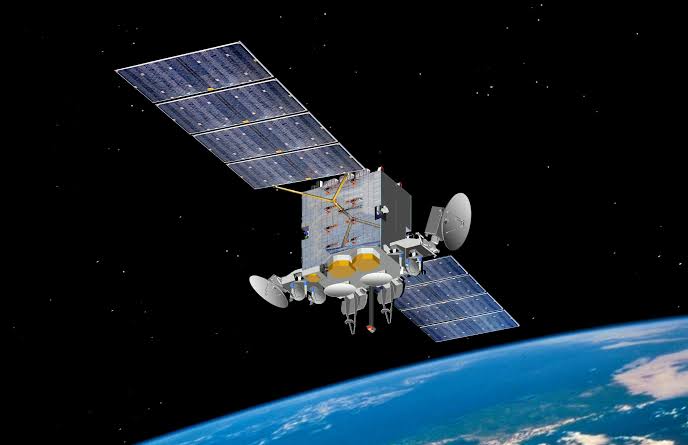
Nigeria is preparing to do more than launch new communications satellites. It also wants to build some of the equipment needed to operate them locally.
Nigerian Communications Satellite Limited (NIGCOMSAT) has selected US satellite communications company Hughes Network Systems’ JUPITER ground system for its next two communications satellites, NIGCOMSAT-2A and 2B, which are expected to launch in 2028 and 2029.
As part of the deal, Hughes will provide technical and engineering support for a facility in Nigeria that will assemble satellite terminals.
These terminals include antennas and other equipment that send signals to satellites and receive them back on Earth. They are a critical part of the ground infrastructure that turns a satellite in orbit into actual connectivity services for people, businesses and government agencies.
For Nigeria, the significance goes beyond having new satellites in space.
The country is trying to capture more of the work that happens on the ground.
Rather than importing all the equipment required to use its satellites, NIGCOMSAT plans to develop local capacity to assemble some of the hardware. If the facility develops beyond the current programme, it could help build expertise in satellite equipment, create jobs and potentially position Nigeria to service terminals for other African markets.
But there is still a big question: will this become the foundation of a lasting satellite hardware industry, or will the local assembly effort remain tied mainly to NIGCOMSAT’s new satellites?
NIGCOMSAT said the project will focus on equipment used to connect satellites with users on Earth, including terminals, dishes, cables and related ground infrastructure.
Hughes will develop the ground segment, while Thales Alenia Space and Israel Aerospace Industries (IAI) are building the satellites. The goal is to have the ground systems and local assembly capability ready ahead of the planned launches.
The move marks a potential change in Nigeria’s approach to satellite infrastructure. Historically, the country has invested in satellites and the facilities required to control and operate them, while relying heavily on imported equipment.
Now, it is looking to keep more of that value within the country.
“Being contracted by NIGCOMSAT for this strategic national program reflects the strength, flexibility, and proven performance of our JUPITER platform,” Anshu Vij, Managing Director, EMEA at Hughes, said in a joint statement with NIGCOMSAT.
The JUPITER system will support Ka-, Ku- and C-band services, allowing NIGCOMSAT to provide capacity for broadband, enterprise and government users in Nigeria and the wider region. Preparation is expected to begin in 2026.
For NIGCOMSAT, building the ground infrastructure is not optional.
“Each satellite launch must have a ground station,” a NIGCOMSAT spokesperson said, explaining that terminals for the new satellites cannot simply be carried over from NigComSat-1R as the satellite approaches the end of its operational life.
Nigeria’s experience with satellite ground infrastructure goes back nearly two decades.
When NigComSat-1 launched in 2007, Nigeria established a Master Control Station in Abuja, alongside a backup tracking facility in Kashgar, China. But the satellite suffered a solar-array failure in 2008 and was eventually de-orbited.
Its replacement, NigComSat-1R, launched in 2011. The Abuja Master Control Station was recalibrated and upgraded with new baseband equipment, tracking antennas and satellite-control software. NIGCOMSAT also expanded its ground infrastructure to Lagos, Kaduna and Gombe to support C-, Ku- and Ka-band services.
The challenge has been turning that infrastructure into sustained commercial demand.
The growth of subsea fibre networks and relatively low demand for NigComSat-1R capacity limited the commercial potential of some of the infrastructure. NIGCOMSAT later explored services such as Teleport-as-a-Service and adapted parts of its facilities to support other satellite operators and orbits.
The Hughes partnership adds something new to that story which is manufacturing.
NIGCOMSAT Managing Director Jane Egerton-Idehen said the partnership could support local manufacturing, innovation, job creation, economic diversification and greater control over Nigeria’s satellite communications infrastructure.
“The JUPITER platform will allow us to efficiently deploy capacity today, while scaling to meet the country’s long-term connectivity needs,” she said.
The proposed facility could eventually matter beyond NIGCOMSAT’s own satellites. If Nigeria can develop the skills, supply chains and technical expertise needed to assemble and maintain satellite terminals at scale, the facility could become part of a broader local space industry.
For now, however, the real test is what happens after the satellites are launched.
Local assembly is a start. Whether it grows into a sustainable space hardware business will depend on how much of the technology, skills and value chain ultimately stays in Nigeria.