


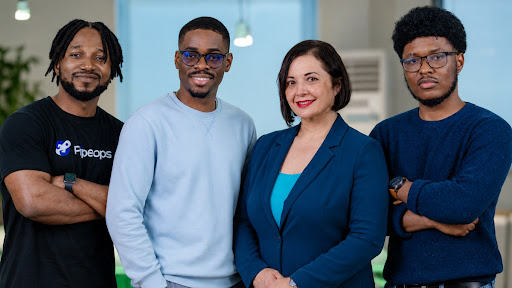
Nigerian cybersecurity startup Aeon has secured additional backing from investors, bringing its pre-seed funding round to $2 million as it looks to strengthen its products and expand its engineering team.
The latest extension attracted investments from Launch Africa Ventures and Octerra Capital, alongside existing backers Terra Industries, Resilience17, the venture fund founded by Flutterwave co-founder and CEO Olugbenga Agboola, Kaleo, DFS Labs, Ajim Capital and Seedstars.
The new funding follows Aeon’s initial $1 million pre-seed round in September, which was led by Terra Industries, a Nigerian defence technology company.
Beyond the investment, the two companies are building a commercial partnership and plan to establish a joint venture to pursue some of Terra Industries’ corporate and government contracts.
Founded by Samuel Ogbonyomi, Ben Eluan and Alex Idowu, Aeon began operations in February 2026 through PipeOps, a cloud infrastructure management platform. The startup currently offers two cybersecurity products designed to help organisations identify and manage security risks.
Its first product, Aeon Console, is an artificial intelligence-powered web platform that helps businesses monitor their cloud infrastructure, identify security weaknesses and address compliance issues.
The second, Aeon Edge, is a network security device installed within an organisation’s network. It gives security teams a clearer picture of connected devices and activity across their networks, helping them identify potential threats.
“We need to build the infrastructure, technical expertise, and capabilities to defend the systems our economies depend on. We believe Africa should be actively building that future,” Ogbonyomi said in a statement.
Aeon said the new capital would support the expansion of its engineering and cybersecurity teams, strengthen local technical expertise and accelerate product development. The company also plans to move its existing pilot projects towards full commercial deployment.
Rising cyber threats create demand for local security solutions
Aeon’s expansion comes as businesses and institutions across Africa face increasingly sophisticated cyber threats.
According to INTERPOL’s African Cyberthreat Assessment 2026, artificial intelligence is now linked to approximately 55% of reported cybercrime across the continent. The organisation also reported that financial losses from cybercrime more than doubled between 2024 and 2026, rising from $192 million to $484 million.
Artificial intelligence is changing how cybercriminals operate by making it easier to launch attacks that previously required significant technical expertise. Phishing campaigns, for example, can now be created and deployed more quickly, while automated tools can help attackers identify weaknesses across digital systems.
In a three-part documentary released by Aeon, the company’s leadership explained how AI is lowering the barriers to cyberattacks and allowing malicious actors to operate at greater speed and scale.
Microsoft’s 2025 Digital Defence Report found that AI-generated phishing emails recorded a 54% click-through rate, compared with 12% for messages written by humans. The findings highlight how artificial intelligence can make fraudulent messages more convincing and increase the chances of victims falling for online scams.
However, AI is not only strengthening the capabilities of cybercriminals. Security teams are also using the technology to investigate incidents, identify vulnerabilities and analyse information across multiple systems.
By reducing repetitive manual tasks, AI-powered security tools can help organisations detect threats faster and respond more effectively.
“AI is fundamentally changing the threat landscape. The technical barriers that previously limited sophisticated cyberattacks are falling, and the speed and scale of these threats are increasing,” Ogbonyomi said.
Despite the growing need for protection, many African organisations still depend on several cybersecurity products that operate separately. This often leaves security teams to gather information from different platforms before they can understand their exposure and determine which threats require immediate attention.
Aeon’s documentary also identifies the high cost of cybersecurity licences, complex integration processes and a shortage of specialised professionals as obstacles preventing organisations from building stronger security systems.
Competing in a crowded cybersecurity market
Aeon is entering a market dominated by established global cybersecurity companies such as Palo Alto Networks, Fortinet and Check Point. It will also face competition from African cybersecurity providers, including Kenya’s Serianu and Morocco’s Nucleon Security.
The startup is betting that a stronger understanding of local infrastructure, regulatory requirements and operating conditions can help it develop security products that better serve African organisations.
Its broader ambition is to build sovereign cyber defence infrastructure for Africa and the Global South, giving organisations greater control over how their digital systems are protected.
For investors, the opportunity is tied to the growing importance of cybersecurity as more essential services move online.
“For two years we have looked for a team building cyber defence for Africa’s critical infrastructure from the ground up,” Uwem Uwemakpan, Head of Investments at Launch Africa Ventures, said in a statement.
“As AI makes attacks cheaper to launch and harder to detect, banks, grid operators and telecoms across the continent need security built for their own systems and regulators. That is what Aeon is building.”