







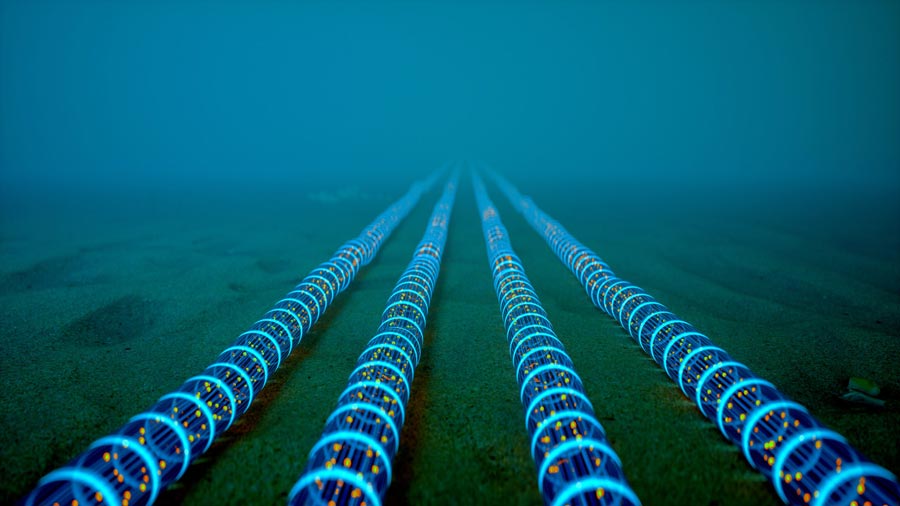
Orange is backing a new 20,000-kilometre subsea cable project that will connect Nigeria with nearly 19 other countries across Africa and Europe, in a major push to strengthen the continent’s digital backbone.
The project, called Via Africa, is being developed by a consortium led by Orange and will stretch across the Atlantic Ocean, making it one of the longest submarine cable systems serving Africa. For context, Meta’s 2Africa cable remains the world’s longest at about 45,000 kilometres.
Nigeria, already one of Africa’s most connected markets, currently hosts eight submarine cables—the highest number in West Africa. But despite this advantage, the country continues to grapple with frequent fibre cuts, vandalism, and network congestion, even as internet demand grows rapidly.
Michaël Trabbia, CEO of Orange Wholesale, said redundancy is now essential to keeping Africa online.
“Every two days somewhere in the world you have a cable cut or failure,” he said. “You need different routes to make sure that when you have one or two cable cuts, you still have connectivity.”
The Via Africa project is still open to additional partners, and final landing points are expected to evolve as more operators join the consortium. Early plans include landings in Nigeria, Senegal, Guinea, Côte d’Ivoire, and Mauritania.
Across Africa, submarine infrastructure is expanding, with about 77 active or planned cable systems as of 2025, according to TeleGeography. However, capacity remains unevenly distributed. More than half of the continent’s international bandwidth flows through just five countries Nigeria, South Africa, Egypt, Algeria, and Kenya, highlighting persistent infrastructure gaps.
Recent cable disruptions along the West African coast have also exposed how fragile global connectivity can be, with outages affecting banking systems, fintech platforms, enterprise services, and everyday internet access across multiple countries.
Trabbia said Via Africa is designed to reduce that vulnerability by creating more diverse routing options.
“The more the routes are different, the more you avoid single points of failure,” he said.
He also noted that older subsea cables are becoming less efficient compared to newer systems, which can carry significantly higher volumes of data.
“One cable lifetime is around 20 to 25 years,” he said. “Beyond 10 years old, cables become much more minor contributors to overall traffic because the new cables are much more efficient.”
Although Orange has not disclosed the final capacity of Via Africa, the system is being designed to support long-term growth in data consumption across Africa’s fast-expanding digital economy.
The cable is expected to land in key coastal hubs across West Africa and connect directly to Europe via the Atlantic corridor, bypassing some of the traditional Mediterranean routes. Orange says this design will improve resilience and reduce dependency on existing pathways.
The system is also expected to connect directly to major data centres, potentially attracting hyperscalers and cloud providers looking to expand their footprint across Africa.
“We see hyperscalers investing more and more in Africa,” Trabbia said. “This cable may attract hyperscalers because it is one of the very big and important infrastructure projects to connect Africa.”
Construction timelines are yet to be finalised, but the project is expected to take three to four years once consortium agreements are completed.
Orange also says the cable will use improved protection systems to reduce damage from ship anchors and other maritime activity, one of the leading causes of subsea cable faults. Newer installations are increasingly buried at depths of up to 2,000 metres and reinforced to improve durability.
Via Africa was unveiled on May 12, 2026, at the Africa Forward Summit in Nairobi, which brought together African leaders, French President Emmanuel Macron, and industry executives from across Africa and Europe. At the event, Orange also outlined broader digital commitments, including training three million young people in AI, cybersecurity, cloud computing, and digital entrepreneurship by 2030.
The company plans to double its Orange Digital Centres across Africa and the Middle East from 50 to 100, while supporting more than 500 startups in sectors including fintech, healthcare, agriculture, education, and e-commerce.
The broader push underscores how subsea infrastructure is becoming central to Africa’s digital transformation, as governments and businesses race to scale AI, cloud, and digital services.
“We need this cable to achieve the digital ambition of the continent,” Trabbia said. “All of this will only be possible if we have the right infrastructure within Africa.”


