


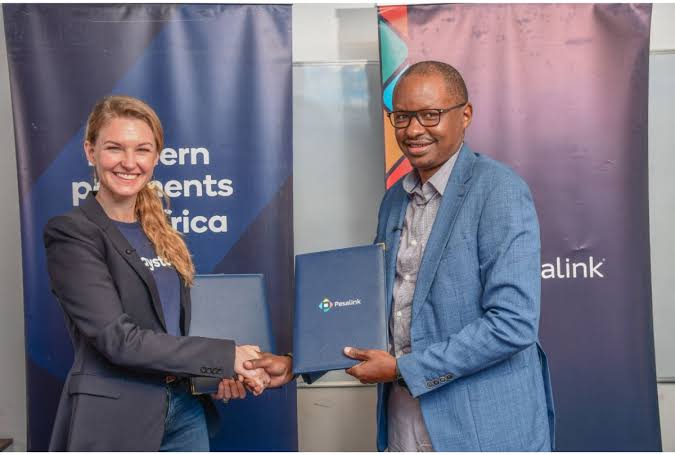
Paystack is making bank transfers a bigger part of its payments strategy in Kenya by expanding its partnership with Pesalink to allow businesses accept payments directly through its checkout page.
The expansion brings customer payments onto the same infrastructure Paystack has used for merchant settlements since 2025, allowing businesses to collect payments, confirm transactions, reconcile accounts and receive settlements through a single payment rail.
The move reflects a broader shift across Africa’s fintech industry, where payment providers are increasingly competing on infrastructure rather than simply offering more payment options. The focus is now on creating faster, more seamless payment experiences by connecting every stage of a transaction from checkout to settlement within one integrated system.
“As demand grows for faster and more reliable payment collection across SMEs, online merchants and B2B companies, integrated payment infrastructure is removing friction between customer intent and business revenue,” Pesalink said in a LinkedIn post announcing the partnership on Thursday.
Paystack has relied on Pesalink since 2025 to process merchant payouts. With the latest integration, that relationship now extends to customer payments, allowing businesses to manage both incoming payments and settlements on the same banking infrastructure.
For customers, the payment process is straightforward. After selecting Pesalink at checkout, they receive a dedicated bank account number and a unique payment reference. Once the transfer is completed through their banking app, the payment is automatically verified by matching the amount and reference, enabling near-instant confirmation for merchants.
The expansion also signals a shift in how Paystack is positioning Pesalink within its payments ecosystem. When the company introduced “Pay with Pesalink” in Kenya in 2025, it was presented as an alternative payment method alongside cards and mobile money. The latest rollout elevates Pesalink from being just another checkout option to serving as core payment infrastructure for businesses.
Operated by Integrated Payment Services Limited under the Kenya Bankers Association, Pesalink connects more than 80 banks and savings and credit cooperatives (SACCOs) across Kenya. The platform has also been expanding its reach. Earlier this year, it partnered with the Pan-African Payment and Settlement System (PAPSS) to enable cross-border transactions in Kenyan shillings.
The Kenyan rollout aligns with Paystack’s broader strategy of tailoring its payment infrastructure to local market preferences. In South Africa, the company introduced Capitec Pay in March 2026, allowing customers to authorise payments directly within the Capitec banking app instead of entering their card details.
In Nigeria, Paystack is also experimenting with AI-powered commerce. In June 2026, the company launched an early-access pilot that enables customers to complete purchases through AI assistants such as Claude and ChatGPT using its Zap bank transfer infrastructure. The initiative reflects Paystack’s belief that AI agents will increasingly become a new interface for online commerce, allowing users to move seamlessly from asking questions to completing transactions.