


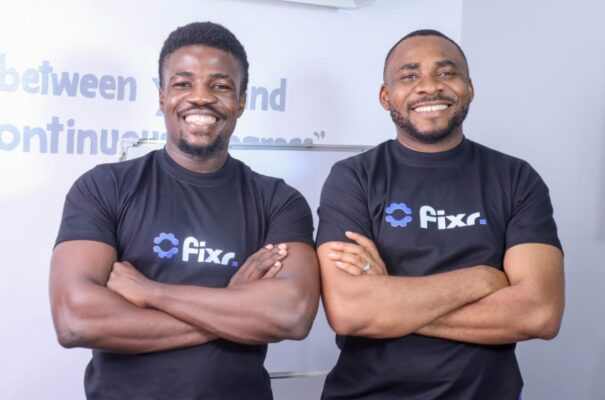
Kechi Adolphus didn’t set out to build a startup. He set out to build a business people could trust—one that could eventually be scaled with technology. That business became Fixr Technologies, the Lagos-based engineering services company he co-founded with Olamide Akangbe. From the outset, Adolphus was clear: Fixr is not a marketplace, nor just a platform connecting customers with technicians.
Since pivoting to a technology-driven model in early 2023, Fixr has expanded across multiple Nigerian states and has a presence in Ghana and Nairobi. It employs roughly 400 technicians most on full-time salaries, manages five to six dark stores for component warehousing, runs an in-house logistics network, and has processed nearly ₦5 billion in gross merchandise value through its renewable energy financing arm alone.
By Adolphus’ account, Fixr grew sevenfold year-over-year in its last full year and is on track to grow ten times that figure in 2026. Remarkably, it has done all of this without raising a single naira from investors.
Traditional marketplace models posed a challenge: if a technician does excellent work, the satisfied customer often bypasses the platform the next time. If the technician underperforms, the customer simply does not return. Either way, the platform loses.
“We tried that model, and it does not scale. Whether customers come to us directly or we assign a technician, we lose,” Adolphus explains.
Fixr’s solution was radical: stop acting like an agency and start operating as a full-service contractor. Customers requesting a service never interact directly with technicians. Fixr handles assignment, parts procurement, reporting, customer communication, and payment.
“The customer comes to us, and they don’t have any business with the technician. Fixr has full control,” Adolphus says.
To make this model sustainable, all technicians are salaried employees—a significant fixed cost for a company without external funding. Salaries give Fixr authority over assignments, work quality, and follow-ups, ensuring accountability and consistency that marketplaces often cannot enforce.
Fixr operates in seven core engineering categories: HVAC, renewable energy and solar, electrical and fitting, electronics, CCTV and surveillance, fibre optics and communications, and home automation. These sectors were deliberately chosen for scalability and long-term relevance.
The renewable energy segment, in particular, has been transformative. Fixr not only installs solar systems but also offers a financing product for customers who cannot afford upfront payments. Partnering with institutions like Checkoff Finance and Sterling Bank, the company provides asset-backed credit with flat interest rates of 4% per month and repayment cycles from three to twelve months. Early repayments are charged only for the months used. This product alone has generated nearly ₦5 billion in GMV over two years.
Adolphus emphasizes that Fixr is not a software company. it’s a service business layered with technology. Akangbe, his co-founder, ran an electrical repair outlet before they met. The technology at Fixr is designed to democratize and scale value, not just build apps.
Fixr’s tech stack has three layers:
- Internal operations software to track jobs, assignments, components, and maintenance schedules.
- Technician-facing app for task visibility, logistics support, and performance tracking.
- Customer-facing app for service requests, maintenance management, inspection reports, component costs, and solar loan tracking.
The apps are particularly useful for subscription customers and solar financing clients, enabling smooth operations and accountability.
Fixr has grown without venture capital, relying on reinvested profits and structured debt from partners like Sterling Bank and Checkoff Finance. This model has required careful financial discipline, optimizing cost allocation, leveraging credit lines for working capital, and reinvesting margins rather than distributing them. The approach has slowed expansion but insulated the company from equity dilution and investor pressure that can destabilize other startups.
The results speak for themselves. Since launching in its current form in early 2023, Fixr’s revenue exceeded ₦3 billion in 2025. Adolphus expects 2026 to deliver a tenfold increase, proving that with the right mix of trust, discipline, and technology, a homegrown service business can scale without outside funding.