


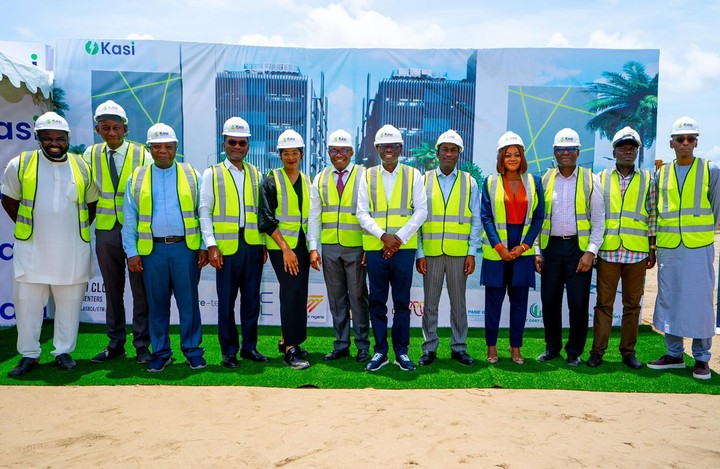
Lagos State is planning a major expansion of its digital backbone, targeting more than 250 megawatts (MW) of data centre capacity by 2030 as demand for cloud computing and artificial intelligence continues to surge across Nigeria’s tech ecosystem.
The announcement was made by Olatubosun Alake, the Commissioner for Innovation, Science, and Technology, who said Lagos already accounts for nearly three-quarters of the country’s commercial data centre capacity. The state now wants to scale that footprint significantly over the next five years.
“There are about 146 additional megawatt data centres planned in the pipeline,” Alake said at the launch of the Kasi Cloud LOS1 facility in Lekki. “We envisage that by 2030, we would have over 250 megawatts of data centre capacity in Lagos.”
That figure signals how quickly Lagos is positioning itself as the centre of Nigeria’s digital infrastructure push, as rising demand for AI computing power, cloud services, and local data storage reshapes investment priorities.
The state is home to one of Africa’s largest startup ecosystems, valued at over $15 billion, and policymakers believe that growth will continue to drive heavy investment into data infrastructure.
Research firm Arizton Advisory & Intelligence projects that Nigeria could become Africa’s fastest-growing data centre market, with annual investments reaching nearly $770 million by 2031.
Alake said the newly launched Kasi Cloud facility reflects Lagos’ shift toward advanced computing infrastructure.
“Lagos is no longer simply a startup city,” he said. “It is an infrastructure city.”
The Kasi LOS1 campus is a 40MW hyperscale data centre, starting operations with a 7.2MW IT load. It is equipped with GPU-powered systems using Nvidia H100 and H200 chips, along with liquid cooling technology designed to handle AI-heavy workloads.
Alake said such infrastructure will become increasingly essential as AI adoption accelerates, adding that Lagos is also investing in fibre networks, smart city systems, university innovation programmes, and digital public services to support the transition.
“The AI economy is going to require hundreds of megawatts,” he said. “The market has already made its decision about where digital infrastructure belongs.”
For Kasi Cloud CEO Johnson Agbogun, the project is also about reducing Nigeria’s dependence on foreign cloud providers.
“Nigerian enterprises are currently spending $850 million every year on foreign cloud infrastructure,” he said. “Every naira spent abroad on cloud and AI infrastructure helps build capabilities somewhere else.”
He described the Lekki facility as “the beginning of Nigeria’s AI factory,” saying it will support GPU-driven workloads for local businesses.
The project has also attracted backing from the Nigeria Sovereign Investment Authority (NSIA), which invested $8 million through a convertible loan note. NSIA executive director Kolawole Owodunni said countries that control their compute infrastructure will be better positioned in the global AI economy.
Still, operators face significant headwinds, including a 64.1% rise in energy costs since early 2026, unreliable national power supply fluctuating between 3,000MW and 4,000MW, foreign exchange volatility, and high cooling demands that can account for up to 40% of operating costs.
Despite these challenges, officials say Lagos is steadily cementing its role as Africa’s emerging digital infrastructure hub.
“Lagos is not coming,” Alake said. “It is already here.”