


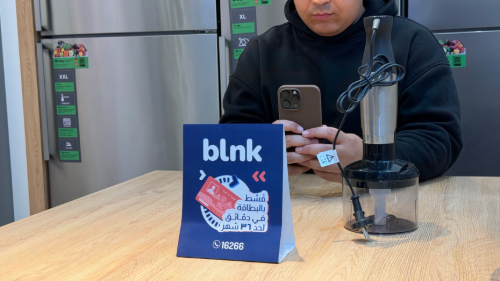
Egyptian fintech startup Blnk has secured $37.1 million in a mix of equity and debt financing as it looks to deepen access to credit for millions of Egyptians who remain excluded from the formal financial system.
The funding package includes a $12.5 million Series A equity round led by Algebra Ventures, with participation from SANAD Fund for MSMEs, Endeavor Catalyst, and existing investor Emirates International Investment Company. The company also secured $24.6 million in local currency debt facilities from several banks and non-bank financial institutions, including National Bank of Egypt, Suez Canal Bank, and Bank Al Baraka Egypt.
Blnk said the fresh capital will be used to expand its lending products, strengthen its technology infrastructure, and support growth opportunities beyond its current markets.
The investment comes at a time when consumer lenders are increasingly targeting Egypt’s large underserved population. As of June 2025, an estimated 16.7 million adults in the country lacked access to formal credit and other banking services. Fintech lenders like Blnk are attempting to close that gap by offering financing solutions that do not require traditional banking relationships, proof of income, or established credit histories.
Founded in 2021 by Amr Sultan and Tarek Elsheikh, Blnk enables consumers to access financing directly at the point of sale through a network of more than 3,000 merchants across Egypt. Customers can finance purchases ranging from electronics and furniture to automotive services and repay over periods of six to 36 months.
According to Amr Sultan, Blnk’s Chief Executive Officer, many of the company’s customers are first-time borrowers.
“About 75% of our customers have never borrowed from a formal lender before, and we are often their first point of access to credit,” Sultan said.
Unlike many of Egypt’s buy-now-pay-later (BNPL) providers, which typically serve consumers already familiar with formal financial products, Blnk focuses on providing instant consumer financing at the point of purchase. Competitors such as valU, Shahry, Souhoola, and Contact Credit generally offer installment-based solutions to consumers with some level of financial inclusion. Blnk, however, is betting on a largely untapped market of first-time borrowers.
The opportunity is significant. Egypt’s consumer finance market reached EGP 61.3 billion ($1.2 billion) in 2024, representing a 29.6% increase from the previous year, according to data from the Financial Regulatory Authority (FRA). While the number of consumers using financing products declined slightly to 3.4 million from 3.7 million in 2023, demand for credit continues to rise.
In March 2025 alone, consumer credit in Egypt grew by 22.7% year-on-year to EGP 1.51 billion ($29 million), underscoring the sector’s continued expansion.
To assess borrowers with limited or no credit histories, Blnk relies on proprietary machine learning models and alternative data sources. The company says this technology-driven approach has enabled it to lend responsibly while maintaining profitability.
Since launch, Blnk has onboarded more than one million customers and built a loan portfolio worth over EGP 1 billion ($21 million). The company also reported a 173% year-on-year increase in revenue and said it achieved profitability in 2025.
A key part of that growth strategy has been its reliance on local-currency funding. By raising debt in Egyptian pounds rather than dollars, Blnk has largely avoided the foreign exchange risks that have affected many businesses during recent currency devaluations.
“We’ve never relied on dollar-based venture debt financing,” Sultan said. “As a result, we were not exposed to FX-related losses on our balance sheet.”
With fresh funding in hand, Blnk plans to scale its reach across Egypt’s consumer market, using its data-driven underwriting model to bring more first-time borrowers into the formal financial system and help close one of the country’s largest financial inclusion gaps.